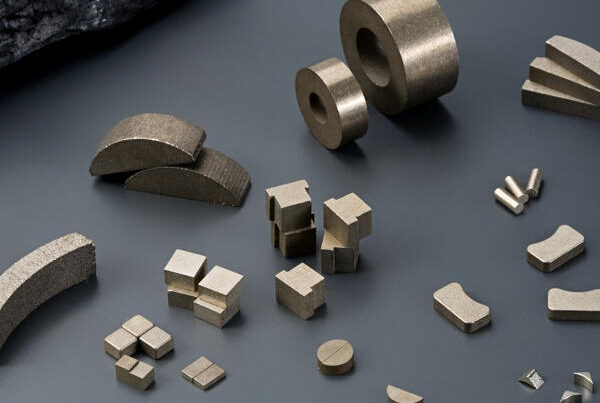

Dans le domaine des matériaux magnétiques, rare earth permanent magnets and ferrite magnets are two important materials that are widely used. Each of them has unique properties and characteristics, playing crucial roles in different fields. Understanding the differences between them helps us make more appropriate choices in practical applications. This article will explore the differences between rare earth permanent magnets and ferrite magnets in detail from multiple aspects.
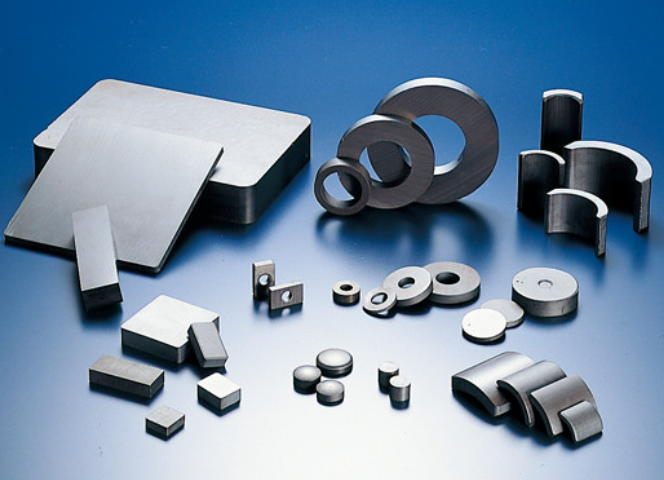
1. Composition and Structure
(1)Rare Earth Permanent Magnets
Aimants permanents aux terres rares are mainly composed of rare earth elements (comme le néodyme, samarium, etc.) and transition metals (such as iron, cobalt, etc.). Take the neodymium-iron-boron permanent magnet as an example. It is a tetragonal crystal composed of neodymium (Nd), fer (Fe), et du bore (B). This unique chemical composition and crystal structure endow rare earth permanent magnets with extremely high intrinsic coercivity and residual magnetic induction. It’s like a strong castle with a tight and orderly internal structure, allowing the magnetism to exist stably and strongly.
(2)Ferrite Magnets
Aimants en ferrite are composite oxides mainly composed of iron oxide (Fe₂O₃). Common ferrite magnets include barium ferrite (BaO·6Fe₂O₃) and strontium ferrite (SrO·6Fe₂O₃). Its crystal structure is usually of the spinel or magnetoplumbite type. This structure is relatively loose, like a building composed of many small rooms. Although it can also generate magnetism, the strength and stability of the magnetism are inferior to those of rare earth permanent magnets.
2. Propriétés magnétiques
(1)Energy Product
The energy product is an important indicator to measure the ability of a magnet to store and convert magnetic energy. Aimants permanents aux terres rares have extremely high energy products. Par exemple, the energy product of neodymium-iron-boron permanent magnets can reach 200 – 400 kJ/m³. This means that under the same volume, rare earth permanent magnets can generate a stronger magnetic field. It’s like an efficient energy storage device that can store more magnetic energy. En revanche, the energy product of ferrite magnets is relatively low, generally between 10 – 40 kJ/m³, and its ability to store magnetic energy is significantly weaker.
(2)Coercivity
Coercivity represents the ability of a magnet to resist demagnetization. Aimants permanents aux terres rares have high coercivity and can maintain their magnetism under the interference of a strong external magnetic field. Par exemple, samarium-cobalt permanent magnets have excellent high-temperature coercivity and can maintain stable magnetism even in high-temperature environments. En revanche, ferrite magnets have relatively low coercivity and are more likely to be demagnetized when subjected to a strong external magnetic field, just like a not-so-strong defense line that is easy to break through.
(3)Residual Magnetism
Residual magnetism refers to the magnetic induction intensity retained by a magnet after the external magnetic field is removed after magnetization. Aimants permanents aux terres rares have a large residual magnetism, which enables them to generate a strong magnetic field in practical applications. Taking neodymium-iron-boron as an example, its residual magnetism can reach 1.0 – 1.4 T. En revanche, ferrite magnets have a small residual magnetism, generally between 0.2 – 0.4 T, and the magnetic field intensity they generate is relatively weak.
3. Physical Characteristics
(1)Density
Aimants permanents aux terres rares have a relatively large density, usually between 7 – 8 g/cm³. This is because their raw materials contain rare earth elements and transition metals with relatively large atomic masses. The large density makes rare earth permanent magnets may not be suitable for some applications with weight requirements. En revanche, ferrite magnets have a small density, generally between 4.5 – 5.2 g/cm³, and are relatively lightweight, which has an advantage in some weight-sensitive occasions, such as small electronic devices.
(2)Hardness and Brittleness
Rare earth permanent magnets have high hardness but are also very brittle. During the processing, cracks and breakage are prone to occur, and special processing techniques are required. Par exemple, when cutting neodymium-iron-boron permanent magnets, high-precision cutting equipment is needed, and appropriate cooling and protection measures should be taken. En revanche, ferrite magnets have relatively low hardness and less brittleness, and are relatively easy to process. They can be processed by traditional mechanical processing methods.
(3)Temperature Stability
Aimants permanents aux terres rares ont une mauvaise stabilité de la température. Especially for neodymium-iron-boron permanent magnets, their Curie temperature is relatively low, and their magnetism will decline rapidly in high-temperature environments. Par exemple, when the temperature exceeds 150°C, the performance of neodymium-iron-boron permanent magnets will be significantly affected. En revanche, ferrite magnets have good temperature stability, with a high Curie temperature, and can maintain relatively stable magnetism in a wide temperature range, which is suitable for some applications in high-temperature environments.
4. Cost and Application Fields
(1) Cost
Rare earth permanent magnets are expensive because their raw materials contain scarce rare earth elements and the production process is complex. Par exemple, neodymium-iron-boron permanent magnets are relatively expensive, which limits their application in some cost-sensitive fields. En revanche, ferrite magnets have a wide range of raw material sources, a relatively simple production process, and low cost, with high cost-effectiveness.
(2) Application Fields
Due to their excellent magnetic properties, rare earth permanent magnets are widely used in fields with high magnetic requirements. Par exemple, in the drive motors of electric vehicles, using rare earth permanent magnets can improve the efficiency and power density of the motor, enabling electric vehicles to have better power performance. In the field of wind power generation, rare earth permanent magnet generators can improve power generation efficiency and reduce costs. En revanche, due to their low cost and good temperature stability, ferrite magnets are often used in fields where the magnetic requirements are not particularly high, such as speakers, TV deflection coils, and toys.
In conclusion, there are significant differences between rare earth permanent magnets and ferrite magnets in terms of composition and structure, magnetic properties, physical characteristics, cost, and application fields. In practical applications, we need to comprehensively consider various factors according to specific needs and scenarios and choose the appropriate magnetic material. With the continuous development of science and technology, these two magnetic materials will also be continuously improved and innovated to provide stronger support for the development of various fields.