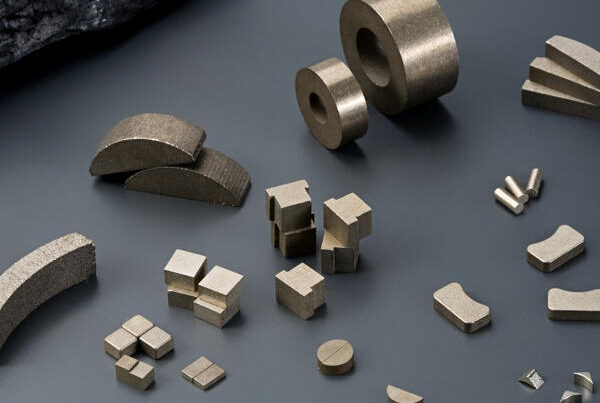

자성재료 현대 전자제품에 꼭 필요한 기능성 소재입니다., 전력 시스템, 연락, 및 산업 장비. 구성 및 자기 특성을 기반으로 함, 일반적으로 사용되는 자성 재료에는 페라이트 자석이 포함됩니다., 네오디뮴 철 붕소 (ndfeb) 자석, 사마륨 코발트 (SMCO) 자석, 알루미늄 니켈 코발트 (Alnico) 자석, 및 연자성 합금. 그중, 페라이트 자성 재료는 저렴한 비용으로 인해 가전제품 및 산업 응용 분야에서 중요한 역할을 합니다., 우수한 화학적 안정성, 그리고 넓은 적용성. 이 기사에서는 재료 구성 측면에서 페라이트 자석과 다른 주요 자성 재료를 체계적으로 비교합니다., 자기 성능, 온도 안정성, 비용, 및 애플리케이션 시나리오.
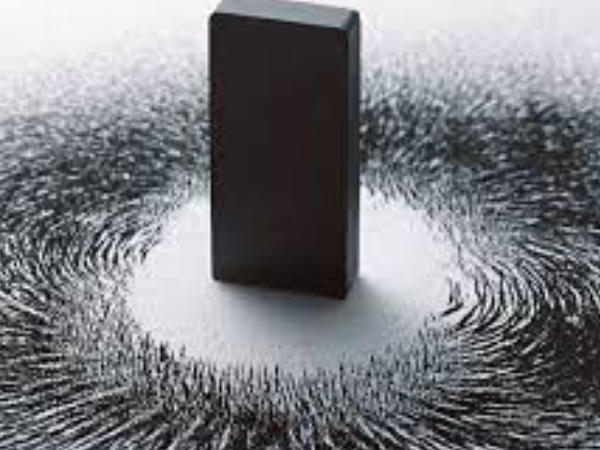
1. 페라이트 자성재료 개요
페라이트 자석 주로 산화철로 구성된 세라믹 자성 재료입니다. (Fe₂O₃) 아연과 같은 금속 산화물과 결합, 망간, 니켈, 바륨, 또는 스트론튬. 기능에 따라, 페라이트는 소프트 페라이트로 분류될 수 있습니다. (예를 들어, Mn-Zn and Ni-Zn ferrites) and permanent ferrites (예를 들어, barium ferrite and strontium ferrite).
The most notable characteristics of ferrite materials are their high electrical resistivity, low eddy current losses, and strong chemical stability. These properties make ferrites particularly suitable for medium- and high-frequency magnetic applications.
2. Comparison Between Ferrite and Neodymium Iron Boron (ndfeb) Magnets
Magnetic Performance
Neodymium iron boron magnets have the highest maximum energy product among all commercial permanent magnets, providing significantly stronger magnetic force than ferrite magnets. NdFeB magnets are especially advantageous in applications where space is limited and high magnetic field strength is required.
대조적으로, ferrite magnets have lower energy product and remanence. 하지만, their magnetic performance is more stable and less affected by external environmental factors.
Temperature and Environmental Resistance
Ferrite magnets exhibit good heat resistance, with some permanent ferrites capable of long-term operation at temperatures around 250 ° C. They also have excellent oxidation resistance. Although ndfeb 자석 offer superior magnetic strength, they are sensitive to temperature and humidity. At elevated temperatures, NdFeB magnets are prone to demagnetization and usually require protective surface coatings.
Cost and Applications
Ferrite magnets are made from abundant raw materials and have low manufacturing costs, making them suitable for large-scale production. NdFeB magnets rely on rare earth elements, which are subject to price fluctuations and significantly higher costs.
결론:
High magnetic strength and compact size → NdFeB is more suitable
Cost-sensitive and harsh environments → Ferrite offers greater advantages
3. Comparison Between Ferrite and Samarium Cobalt (SMCO) Magnets
Samarium cobalt magnets are well known for their excellent high-temperature stability. They can operate continuously at temperatures above 300 ° C, with high Curie temperatures and minimal magnetic degradation.
Compared with SmCo magnets, ferrite magnets offer slightly lower high-temperature performance but still outperform many conventional magnetic materials. 게다가, SmCo magnets are expensive, brittle, and difficult to machine, whereas ferrite magnets are more suitable for mass production.
결론:
Extreme high-temperature and aerospace applications → SmCo
General industrial use with high cost efficiency → Ferrite
4. Comparison Between Ferrite and Aluminum Nickel Cobalt (Alnico) Magnets
Alnico 자석 feature high remanence and good temperature stability. 하지만, they have relatively low coercivity and are easily demagnetized by external magnetic fields.
Ferrite magnets have significantly higher coercivity than AlNiCo magnets, making them more resistant to demagnetization and more stable for long-term use. Nevertheless, AlNiCo magnets still demonstrate better magnetic stability than ferrites at very high temperatures.
결론:
Applications requiring high remanence and controlled magnetic circuits → AlNiCo
Demagnetization resistance and long-term stability prioritized → Ferrite
5. Comparison Between Ferrite and Soft Magnetic Metal Materials
Soft magnetic materials such as silicon steel, permalloy, and amorphous alloys are mainly used in magnetic cores and electromagnetic energy conversion applications.
Key Differences
페라이트: High electrical resistivity, suitable for high-frequency applications with low energy loss
Soft magnetic metals: High saturation magnetic flux density, suitable for low-frequency or high-power applications
Ferrite cores are widely used in switching power supplies, EMI suppression, 인덕터, and transformers due to their low eddy current losses.
6. Summary of the Main Advantages and Disadvantages of Ferrite Magnets
장점
- Abundant raw materials and low cost
- High electrical resistivity, suitable for high-frequency applications
- Excellent corrosion and oxidation resistance
- 높은 강압, resistant to demagnetization
- Well suited for large-scale industrial production
단점
- Lower maximum energy product and magnetic strength
- Brittle material with limited impact resistance
- Not suitable for applications requiring extremely high magnetic flux density or compact size
7. Application Scenario Comparison
| Application Area | 추천 소재 | Reason |
| 소비자 전자 장치 | 페라이트 | Low cost and good stability |
| Switching power supplies | Soft ferrite | Low loss at high frequency |
| 고성능 모터 | ndfeb | Strong magnetic force and high efficiency |
| High-temperature environments | SMCO / 페라이트 | Excellent thermal stability |
| Automotive electronics | 페라이트 / ndfeb | Balanced reliability and performance |
결론
Although ferrite magnetic materials do not match the magnetic strength of NdFeB or SmCo magnets, they maintain an irreplaceable position in electronics, power, and industrial applications due to their cost advantages, environmental stability, high-frequency performance, and strong resistance to demagnetization. Each magnetic material has its own strengths, and proper material selection should be based on operating temperature, 자기 성능 요구 사항, cost constraints, and environmental conditions to achieve the optimal balance between performance and economics.
To learn more information,you can visit our website:https://jlmag-innovation.com/
TEL:86 181 7907 4071
EMAIL: sales01.jlmaginnovation@jlmag.com.cn