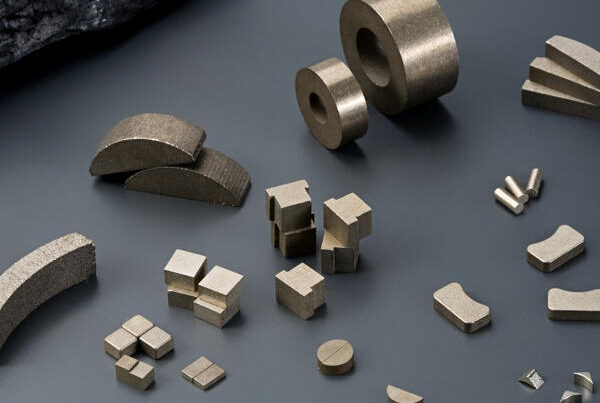

Magnetic materials are essential functional materials in modern electronics, sistemas de energia, comunicações, e equipamentos industriais. Based on composition and magnetic properties, commonly used magnetic materials include ferrite magnets, neodymium iron boron (Ndfeb) ímãs, samarium cobalt (SMCO) ímãs, aluminum nickel cobalt (Alnico) ímãs, and soft magnetic alloys. Entre eles, ferrite magnetic materials play an important role in consumer electronics and industrial applications due to their low cost, excellent chemical stability, and wide applicability. This article provides a systematic comparison of ferrite magnets with other major magnetic materials in terms of material composition, magnetic performance, temperature stability, cost, and application scenarios.
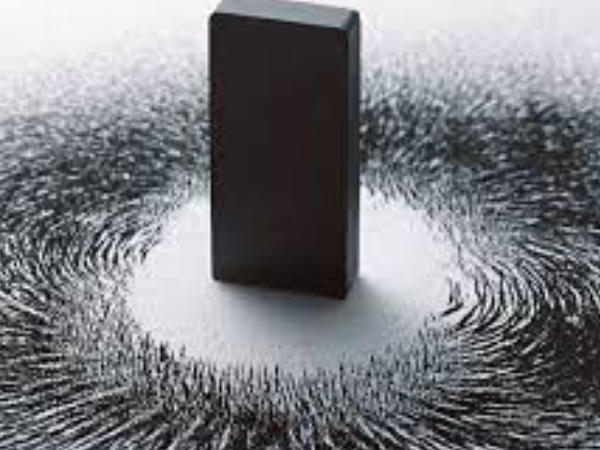
1. Overview of Ferrite Magnetic Materials
Ímãs de ferrite are ceramic magnetic materials primarily composed of iron oxide (Fe₂O₃) combined with metal oxides such as zinc, manganese, níquel, barium, or strontium. Depending on their function, ferrites can be classified into soft ferrites (e.g., Mn-Zn and Ni-Zn ferrites) and permanent ferrites (e.g., barium ferrite and strontium ferrite).
The most notable characteristics of ferrite materials are their high electrical resistivity, low eddy current losses, and strong chemical stability. These properties make ferrites particularly suitable for medium- and high-frequency magnetic applications.
2. Comparison Between Ferrite and Neodymium Iron Boron (Ndfeb) Magnets
Magnetic Performance
Neodymium iron boron magnets have the highest maximum energy product among all commercial permanent magnets, providing significantly stronger magnetic force than ferrite magnets. NdFeB magnets are especially advantageous in applications where space is limited and high magnetic field strength is required.
In contrast, ferrite magnets have lower energy product and remanence. No entanto, their magnetic performance is more stable and less affected by external environmental factors.
Temperature and Environmental Resistance
Ferrite magnets exhibit good heat resistance, with some permanent ferrites capable of long-term operation at temperatures around 250 ° c. They also have excellent oxidation resistance. Although Ímãs NdFeB offer superior magnetic strength, they are sensitive to temperature and humidity. At elevated temperatures, NdFeB magnets are prone to demagnetization and usually require protective surface coatings.
Cost and Applications
Ferrite magnets are made from abundant raw materials and have low manufacturing costs, making them suitable for large-scale production. NdFeB magnets rely on rare earth elements, which are subject to price fluctuations and significantly higher costs.
Conclusão:
High magnetic strength and compact size → NdFeB is more suitable
Cost-sensitive and harsh environments → Ferrite offers greater advantages
3. Comparison Between Ferrite and Samarium Cobalt (SMCO) Magnets
Samarium cobalt magnets are well known for their excellent high-temperature stability. They can operate continuously at temperatures above 300 ° c, with high Curie temperatures and minimal magnetic degradation.
Compared with SmCo magnets, ferrite magnets offer slightly lower high-temperature performance but still outperform many conventional magnetic materials. Além disso, SmCo magnets are expensive, brittle, and difficult to machine, whereas ferrite magnets are more suitable for mass production.
Conclusão:
Extreme high-temperature and aerospace applications → SmCo
General industrial use with high cost efficiency → Ferrite
4. Comparison Between Ferrite and Aluminum Nickel Cobalt (Alnico) Magnets
Ímãs Alnico feature high remanence and good temperature stability. No entanto, they have relatively low coercivity and are easily demagnetized by external magnetic fields.
Ferrite magnets have significantly higher coercivity than AlNiCo magnets, making them more resistant to demagnetization and more stable for long-term use. Nevertheless, AlNiCo magnets still demonstrate better magnetic stability than ferrites at very high temperatures.
Conclusão:
Applications requiring high remanence and controlled magnetic circuits → AlNiCo
Demagnetization resistance and long-term stability prioritized → Ferrite
5. Comparison Between Ferrite and Soft Magnetic Metal Materials
Soft magnetic materials such as silicon steel, permalloy, and amorphous alloys are mainly used in magnetic cores and electromagnetic energy conversion applications.
Key Differences
Ferrita: High electrical resistivity, suitable for high-frequency applications with low energy loss
Soft magnetic metals: High saturation magnetic flux density, suitable for low-frequency or high-power applications
Ferrite cores are widely used in switching power supplies, EMI suppression, indutores, and transformers due to their low eddy current losses.
6. Summary of the Main Advantages and Disadvantages of Ferrite Magnets
Vantagens
- Abundant raw materials and low cost
- High electrical resistivity, suitable for high-frequency applications
- Excellent corrosion and oxidation resistance
- Alta coercividade, resistant to demagnetization
- Well suited for large-scale industrial production
Desvantagens
- Lower maximum energy product and magnetic strength
- Brittle material with limited impact resistance
- Not suitable for applications requiring extremely high magnetic flux density or compact size
7. Application Scenario Comparison
| Application Area | Material Recomendado | Reason |
| Eletrônicos de consumo | Ferrita | Low cost and good stability |
| Switching power supplies | Soft ferrite | Low loss at high frequency |
| Motores de alto desempenho | Ndfeb | Strong magnetic force and high efficiency |
| High-temperature environments | SMCO / Ferrita | Excellent thermal stability |
| Automotive electronics | Ferrita / Ndfeb | Balanced reliability and performance |
Conclusão
Although ferrite magnetic materials do not match the magnetic strength of NdFeB or SmCo magnets, they maintain an irreplaceable position in electronics, power, and industrial applications due to their cost advantages, environmental stability, high-frequency performance, and strong resistance to demagnetization. Each magnetic material has its own strengths, and proper material selection should be based on operating temperature, Requisitos de desempenho magnético, cost constraints, and environmental conditions to achieve the optimal balance between performance and economics.
Para saber mais informações,você pode visitar nosso site:https://jlmag-innovation.com/
TELEFONE:86 181 7907 4071
E-MAIL: sales01.jlmaginnovation@jlmag.com.cn