
Na rápida evolução dos dispositivos inteligentes modernos, as pessoas geralmente se concentram no desempenho do chip, taxas de atualização da tela, ou sistemas de imagem, while overlooking a hidden but crucial component—magnetic materials. Neodymium iron boron (Ndfeb) ímãs, em particular, as the most powerful commercial permanent magnets currently available, support the miniaturization, lightweighting, and high-performance output of devices. Many core experiences of smart hardware, such as vibration feedback, autofocus, magnetic structures, and high-efficiency motors, directly rely on the performance of NdFeB magnets. This article will comprehensively analyze how NdFeB magnets have become an irreplaceable foundation for smart devices, from material properties and application scenarios to technological advantages and future trends.
EU. Material Properties of Neodymium Iron Boron Magnets
1. High Energy Product (Bhmax)
The energy product of NdFeB magnets can reach 30–52 MGOe, which is 8–12 times that of ferrite magnets. This means that a stronger magnetic field can be provided within the same volume, enabling devices to be lighter and thinner without sacrificing performance. It offers significant advantages in magnetic circuit design for space-sensitive products such as mobile phones and smart wearables.
2. High Remanence and High Coercivity
Ímãs NdFeB have high remanence, enabling them to maintain a stable magnetic field over long periods without requiring continuous external power. Simultaneously, their strong coercivity provides excellent resistance to demagnetization, allowing stable operation even under high temperatures, external magnetic interference, or mechanical shock. For devices such as camera motors and Hall effect sensors, long-term stability is crucial for system reliability.
3. Diverse Magnetization Methods
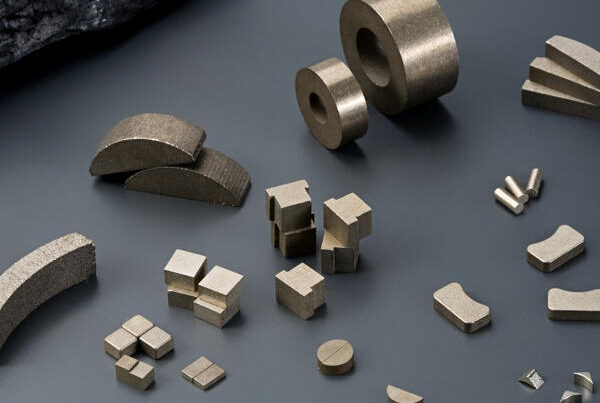
Ímãs NdFeB can be customized in magnetization direction according to device structural requirements, such as axial, radial, and multipole magnetization. Multipole magnetization can improve motor efficiency and enhance sensor sensitivity and signal response speed. Their high machinability makes them suitable for various precision structures and complex applications.
II. Core Applications of NdFeB Magnets in Smart Devices
1. Smartphones
NdFeB magnets are virtually ubiquitous within smartphones, forming a fundamental component of the mobile experience.
Functional Modules, Usage Reasons, Specific Functions
Speakers and Earpieces: Strong magnetic flux density increases sound pressure level, making sound clearer and more penetrating, enhancing the multimedia experience.
Vibration Motors: High driving force and fast response provide users with precise and delicate tactile feedback, such as X-axis linear motors.
Camera Autofocus: Stable magnetic force ensures the accuracy of the focusing mechanism, helping phones achieve fast and accurate autofocus.
Magnetic Structures: Directional magnetization provides stable adsorption; commonly used in magnetic phone cases, wireless charger alignment, etc..
Smartphones have extremely high requirements for magnet size, making neodymium iron boron (Ndfeb) the best choice due to its high magnetic properties.
2. Smart Wearable Devices
Smart wearable devices have even more limited space and stricter requirements for magnets.
Smartwatches use NdFeB magnets to drive speakers, vibration motors, and internal micromotors, making the devices both thin and light yet fully functional. Bluetooth earphones (especially TWS) rely on NdFeB magnets to improve the sensitivity of the sound unit and are also used in the magnetic structure of the charging case to improve user convenience. Além disso, many fitness trackers utilize neodymium iron boron (Ndfeb) magnets in their Hall effect switch modules for precise triggering.
3. Smart Speakers and Acoustic Equipment
High-quality audio systems demand extremely high magnet performance, and NdFeB magnets provide the perfect balance.
Due to their high energy product, the magnetic circuitry of speakers can be made smaller, yet the driving force is stronger, making the voice coil more sensitive in driving the diaphragm, improving high-frequency resolution and low-frequency extension. For devices that continuously output sound, such as smart speakers, NdFeB magnets allow for higher overall power output while maintaining stable sound quality and reducing distortion. Portanto, they have become a commonly used magnetic material in high-end smart speakers.
4. Smart Home and IoT Devices
NdFeB magnets have extremely wide applications in the smart home field, covering multiple dimensions from sensors to motors.
In smart door sensors, NdFeB magnets provide a stable magnetic field, enabling the sensor to continuously and accurately identify the door’s open/closed status. Brushless motors in robotic vacuum cleaners and sweeping robots typically rely on NdFeB as the rotor magnet to improve energy efficiency and torque, enabling faster movement and stronger suction. BLDC motors in air purifiers and smart fans also depend on NdFeB to improve operating efficiency and reduce energy consumption.
5. Automotive Intelligent Systems
As automobiles become increasingly intelligent, the importance of NdFeB magnets continues to grow.
Smart cars extensively use small, high-torque motors, such as the motor platform in autonomous driving radar systems, electric tailgate actuators, window lifts, and seat adjustments. These systems require motors that are highly efficient, long-lasting, and responsive, requirements that NdFeB magnets perfectly meet. Além disso, in-car audio systems and Hall effect sensors also heavily rely on high-performance magnets to achieve more precise responses and higher sound quality.
III. Reasons for the Importance of NdFeB Magnets in Smart Devices
1. Driving Device Miniaturization and Lightweighting
O hardware inteligente busca constantemente designs mais finos e leves, e ímãs NdFeB podem fornecer força magnética extremamente forte em um pequeno volume, reduzindo significativamente o tamanho dos motores, alto -falantes, e sensores. É a base central que permite o design compacto e sofisticado de muitos dispositivos.
2. Eficiência Energética Significativamente Melhorada
Ímãs de alto desempenho podem aumentar o torque de partida do motor e melhorar a eficiência de conversão, tornando os dispositivos inteligentes mais eficientes em termos energéticos. Por exemplo, aspiradores robóticos, escovas de dente elétricas, e dispositivos vestíveis se beneficiam de maior duração da bateria e maior potência.
3. Suporte para alta personalização e estabilidade aprimorada
Os ímãs NdFeB podem ser processados e tratados superficialmente para obter vários formatos e características de resistência ambiental, atendendo às necessidades específicas de diferentes dispositivos. For devices requiring high reliability, such as medical instruments or smart locks, it provides a consistently stable magnetic field output.
4. Technical Challenges and Solutions for NdFeB Magnets
1. Insufficient Corrosion Resistance
Ímãs NdFeB are prone to oxidation in humid environments, leading to performance degradation. To address this, the industry commonly uses nickel plating, zincagem, multi-layer composite plating, or epoxy coatings to enhance corrosion resistance, enabling the magnets to withstand long-term applications. Smart devices typically require more stringent salt spray testing, como 48 hours or more than 72 horas.
2. Limited Temperature Resistance
Ordinary NdFeB magnets are prone to demagnetization in high-temperature environments. Portanto, high-temperature applications require high-temperature resistant magnets such as H, SH, UH, and EH. These magnets improve temperature resistance by adding rare earth elements such as Dy, meeting the high-temperature requirements of motors, automobiles, and other applications.
3. Fluctuations in Raw Material Prices
Rare earth metal prices fluctuate significantly due to policy and market influences. Portanto, the industry is reducing costs through magnetic circuit optimization, material recycling, and rare earth-saving processes. These measures help reduce sensitivity to rare earth price fluctuations and maintain long-term product supply stability.
V. Future Trends: How Will NdFeB Magnets Impact the Development of Smart Devices?
1. Continued Rising Demand for High-Temperature and Ultra-High Coercivity Magnets
With the expansion of applications in motors, small robots, and wearable devices, high-temperature environments are becoming increasingly common. Portanto, NdFeB resistente a altas temperaturas será uma das direções magnéticas de crescimento mais rápido no futuro.
2. Aumento significativo da demanda por ímãs em miniatura
Hardware emergente, como AR/VR, óculos inteligentes, e pequenos atuadores estão ganhando popularidade rapidamente, levando a um aumento exponencial na demanda por ímãs miniatura de NdFeB. Alto desempenho e miniaturização serão foco da próxima etapa.
3. A revolução da tecnologia de motores sem escova impulsiona atualizações magnéticas
Eletrodomésticos inteligentes, robôs, e veículos de novas energias estão sendo atualizados para motores BLDC, expandindo continuamente a demanda por NdFeB e impulsionando melhorias adicionais no desempenho magnético.
4. Revestimentos e reciclagem ecologicamente corretos tornam-se tendências
Com regulamentações ambientais cada vez mais rigorosas, new green coating technologies and rare earth recycling processes will become important directions for the industry, not only reducing costs but also meeting global sustainable development needs.
Conclusão
Ímãs NdFeB have become an indispensable core material for modern smart devices. From the vibration and autofocus of smartphones to the high-quality sound effects of smart speakers, and the efficient motors of robots and automotive intelligent systems, NdFeB supports almost all core experiences of smart devices. No futuro, with the continued expansion of the AI, smart hardware, and robotics industries, the demand for NdFeB magnets will further increase, continuing to drive technological progress in the intelligent industry.